
Do not release a swivel-chair order because the chair fits in one parked position. A back corner, arm, occupant’s foot, or low base can still strike a wall, table, drapery panel, or floor outlet during rotation, forcing damage repairs or a layout change after delivery.
How much clearance does a swivel chair need for a full rotation?
Approve a swivel chair only when its full circular envelope clears every obstruction. Measure clearance from the actual swivel-axis center, not from the chair’s edge in one parked position. Required center-to-obstruction distance = swept radius + a deliberately selected operating buffer.
- Confirm whether the mechanism rotates 360 degrees or stops at a limited angle.
- Account for the chair geometry, pivot location, and upholstery that can compress or flex.
- Add a project-specific buffer for hands, feet, placement tolerance, and normal use. Do not assume a universal buffer without manufacturer guidance or a documented field test.
Overall chair width does not determine swivel clearance
For an upholstered lounge chair in its normal upright configuration, compare the overall width and depth with the swivel-axis position. A deep chair or offset back can place its rear corner farther from the axis than either side arm. That farthest radial projection controls the sweep, even when the chair appears to fit.
The approval decision therefore starts with the swept radius, not a generic gap around the parked chair.
The swept radius determines whether a swivel chair will hit an obstruction
For a 360-degree swivel chair, measure every projection from the swivel-axis center and treat the longest radial distance as the swept radius. If only rectangular dimensions and pivot offsets are available, calculate a conservative corner radius, then check projecting arms, cushions, handles, and controls separately.
Where is the swivel-axis center on the specified chair?
Start with the manufacturer’s dimensioned plan drawing. Locate the rotational axis relative to the seat, back, arms, and base. Do not assume that the center of the seat, center of the base footprint, and midpoint of the overall dimensions coincide. An offset mounting plate or asymmetric frame can move the axis.
When the drawing omits the axis, use the center of a circular swivel base only if the chair construction confirms that relationship. Otherwise, place a laser or plumb reference over the apparent fixed center and rotate the chair slowly. The point that remains stationary is the working origin. Measure four plan-view distances from that origin: left, right, front, and rear.
How is the swivel chair’s conservative clearance radius calculated?
For a centered chair of width W, the basic lateral extent is W divided by two. Front and rear extents still require separate measurements from the pivot because overall depth does not prove that the axis is centered.
For each possible corner, use the farther applicable lateral and longitudinal projections:
Radius = √(lateral extent² + longitudinal extent²)
Keep every measurement in the same unit. Hypothetical example: a chair extends 17 inches to the right and 24 inches behind the axis. Its conservative rear-corner radius is √(17² + 24²), or approximately 29.4 inches. As an explicitly selected planning convention, round that result up to 30 inches before adding the project-specific operating buffer. This rounding method is a layout choice, not an industry standard.
Manufacturer CAD geometry can calculate the true distance from the axis to every point on the actual outline. The rectangular formula instead sweeps the corner of a bounding box, so the result may overstate the clearance needed by a rounded shell. That conservative result is useful when detailed geometry is unavailable.
An offset chair back can control the full rotation envelope
A plan drawing with an axis positioned forward of the back may show a compact base but a long rear sweep. Static rear clearance measures only the gap in one facing position. During rotation, the rear corner can arc sideways into a sofa or table. A projecting arm can create the same problem.

The swept radius determines whether a swivel chair will hit an obstruction shown as an editorial planning reference.
This calculation covers a rigid plan-view envelope on a level floor with the chair upright. Recliner extension, glider travel, rocking movement, movable cushions, and an occupant’s hands or feet require separate allowance. If the pivot position remains uncertain, verify the operating envelope on the floor.
A floor template can verify swivel-chair clearance when drawings are incomplete
When the swivel-axis location is unpublished, verify the assembled chair before approving the layout. Mark the axis, measure the farthest projections, tape the sweep, and test both unoccupied product clearance and occupied operating clearance.
Bring a tape measure, low-tack floor tape suitable for the finished surface, a laser or plumb reference, and the manufacturer’s assembly and operating instructions.
How should a swivel chair be tested before final furniture placement?
- Confirm the test conditions so the result matches the installation. Assemble the chair correctly, place it level on the finished floor, set the mechanism for its intended operation, and install or represent the specified rug and pad.
- Locate the swivel axis so every measurement starts from the true pivot. Rotate the chair through several positions and use a laser or plumb reference to transfer the stable center point to the floor.
- Measure each projection so the template captures the largest radius. Check the arms, back, seat corners, base, controls, and any upholstery that holds its shape beyond the frame.
- Tape the sweep so possible collisions become visible. Mark a circle from the axis using the largest measured projection, then mark the deliberately selected operating buffer outside that product envelope.
- Rotate through multiple angles so intermediate collisions are not missed. Test the empty chair first, then repeat the test occupied if hands, feet, loose cushions, or controls can extend beyond the rigid envelope.
- Record the result so the approved placement can be reproduced. Note the measured radius, selected buffer, nearest obstruction, final center point, and pass-or-fail outcome on the showroom or installer worksheet.
Never drag the chair or force a resistant swivel mechanism. Confirm that the low-tack tape is suitable for the flooring before applying it. Once the circle passes, inspect each obstruction according to how it behaves in use.
Walls, sofas, side tables, drapery, and floor outlets require different swivel-chair checks
Test every obstruction against the same swept radius, then inspect its particular failure mode. Walls and casegoods create fixed impact points. Sofas compress and shift when occupied. Side tables hold objects that can fall. Drapery can move into the sweep, while plugs and cords can interfere below the upholstered body.
A wall measurement must run from the swivel-axis center to the nearest projecting surface, including trim, sills, radiators, door hardware, and other proud details. Passing the flat wall plane is not enough if a baseboard or sill enters the operating envelope.
A sofa measurement must use the nearest arm, cushion, or occupied edge. Check loose back cushions, projecting arms, throws, and the position of a seated person. For a side table, test the tabletop corner, legs, and base separately. Include lamps, trays, books, and other objects extending beyond the top.
Floor outlets need both plan-view and vertical clearance from a swivel chair
A floor outlet is not merely a point on the furniture plan. Confirm the specified floor-box cover dimensions and its height above the finished floor. Add the projection of the intended plug or transformer and show the cord direction. Compare that complete assembly with the chair base and underside throughout rotation.
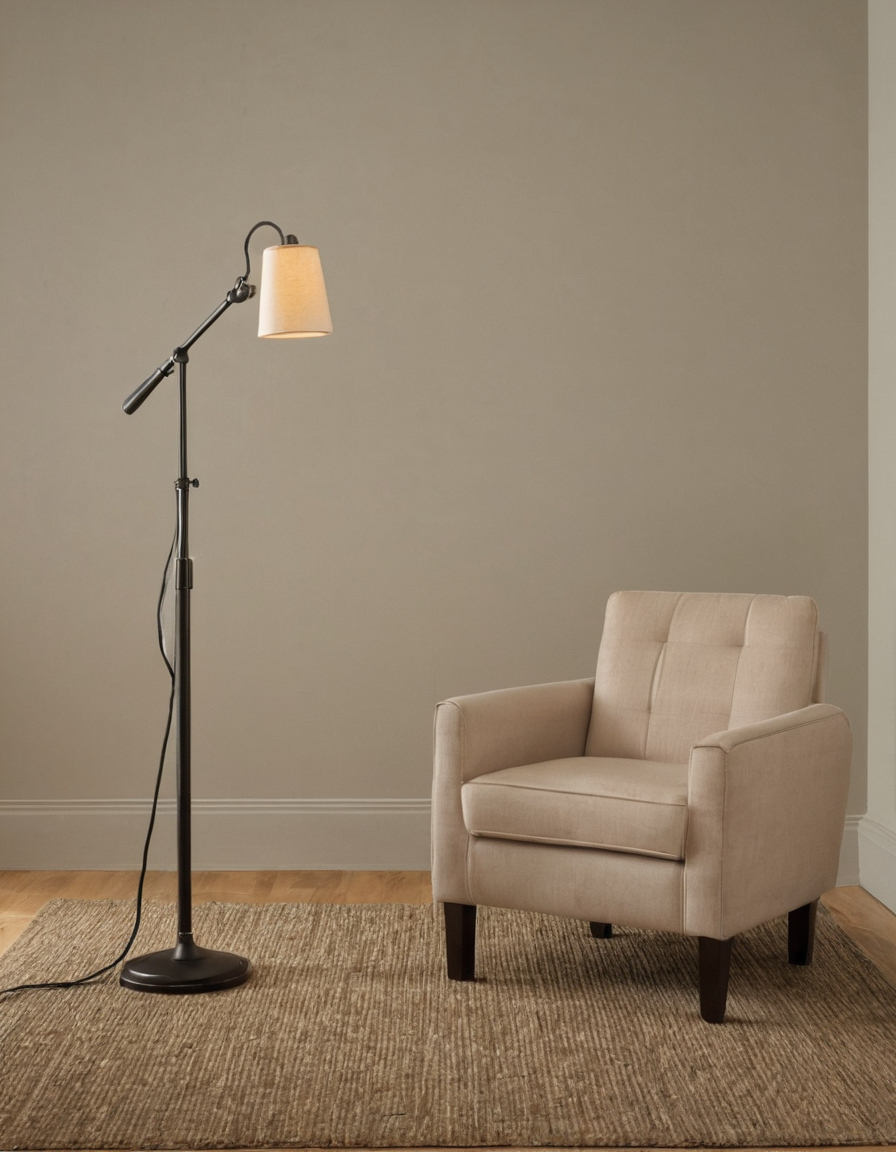
Walls, sofas, side tables, drapery, and floor outlets require different swivel-chair checks shown with practical context cues.
Outlet relocation, cover substitution, and jurisdiction-specific electrical compliance require confirmation from a qualified electrical professional. A chair can clear the floor box in plan yet strike a raised cover, sweep across a plug, or pinch a cord under the base.
Drapery and loose furnishings can move into the swivel-chair envelope
Check full-length drapery at its installed stack depth and normal hanging position, not at the window plane. If room airflow or routine curtain operation moves the fabric, test that movement against the chair sweep. Apply the same test to throws and loose sofa cushions that can slump into the envelope.
The obstruction check defines what the chair must clear. Final approval still depends on the specified chair’s pivot position, base geometry, upholstery profile, and underside clearance.
Current swivel-chair specifications show why model-specific clearance matters
A valid model comparison places overall width and depth beside the swivel-axis location and calculated swept radius. Similar-width chairs can require different clear zones because their backs, arms, and bases project differently around the pivot. Product-page dimensions alone do not establish an operating envelope.
Request a current dimensioned drawing, swivel range, base information, and configuration-specific instructions. Confirm that the drawing matches the exact chair, base, upholstery, and optional controls being ordered. Record the document revision or retrieval date with the specification.
Reject retailer-only dimensions and drawings that omit the pivot unless a verified field measurement closes the gap. Compare each chair upright and exclude any unmeasured recliner, glider, or rocking travel. After the rotation envelope passes, move to the separate circulation check.

Current swivel-chair specifications show why model-specific clearance matters shown with practical context cues.
Swivel-chair rotation clearance does not replace living-room circulation clearance
A chair can rotate without collision and still fail the living-room layout. After plotting the swivel envelope, test the remaining walkway, adjacent-seat access, and table reach in the normal position, a conversational turn, and the most obstructive permitted rotation. For chair pairs, test simultaneous occupied movement.
Draw each chair’s swept envelope from its swivel-axis center. Draw the primary circulation path separately, then identify where the walkway narrows or crosses an operating envelope. Show the specified rug, pad, sofa, tables, and chair centers at their actual planned dimensions.
These checks complement living-room walkway widths, TV distance, and rug sizing. Reliable living room furniture ideas must work while the chair moves and while people pass it.
How much space is needed between two swivel chairs?
For simultaneous full rotation, the center-to-center spacing must equal or exceed the sum of both operating radii, including each selected buffer. A generic edge-to-edge gap cannot confirm clearance.
Intentionally limited rotation may allow closer or staggered placement, but the furniture layout must show the actual sector swept by each chair. Check occupied positions for hands, knees, feet, and loose cushions, especially when both users turn toward the sofa or table at once.
The four-inch furniture rule is not a swivel-clearance specification
Do not apply an unexplained four-inch rule to swivel clearance. Unless an authoritative source and its intended context are identified, treat the figure as unsupported. A static edge gap cannot replace a pivot-based sweep calculation.
The final living room design decision has two gates: the chair’s operating envelope must clear, and the remaining circulation route must still function. Release the layout only after both gates pass.

Swivel-chair rotation clearance does not replace living-room circulation clearance shown with finish, fixture, and clearance relationships visible.
Frequently asked questions
How much space do you need between two swivel chairs?
Measure between the two swivel-axis centers. For simultaneous 360-degree rotation, the spacing must be at least the sum of both swept radii and both selected operating buffers. Test occupied movement before approving the pair.
Can a swivel chair rotate safely when it is placed close to a wall?
Yes, if the wall and every projecting detail remain outside the chair’s operating envelope. Measure from the swivel-axis center to trim, sills, hardware, and other projections rather than checking only the parked rear gap.
Does the four-inch furniture rule apply to swivel chairs?
No universal four-inch rule establishes swivel clearance. Use the specified chair’s pivot position, farthest radial projection, permitted rotation, and project-selected operating buffer.
How much occupied clearance should be added for a person’s hands and feet?
There is no universal occupied buffer. Test the intended chair with representative users and normal postures, then document the additional radius needed for hands, knees, feet, controls, and loose cushions.
What are the layout disadvantages of a swivel chair in a small living room?
A swivel chair occupies a moving circular or sector-shaped envelope that can overlap walkways, tables, drapery, outlets, and adjacent seating. Small-room living room ideas should therefore plot the pivot-based sweep before using the remaining floor area for circulation or storage.